Constraint-Aware Core-Cavity Generation Method for Injection Mold Design
April 10, 2026·,,,,
Wenlin Yu
Defa Liu
Haoran Shi
Ainiwa Aidibai
Hua Geng
Hengkai YAO
Corresponding
·
0 min read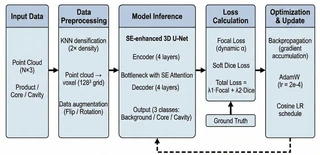 Image credit: Yu
Abstract
To address the challenges in core-cavity design for injection molds-namely reliance on manual experience, low automation, and difficulty in ensuring manufacturability-this paper proposes a constraint-aware core-cavity generation method tailored for injection mold design. Taking product 3D geometric data as input, the method formulates core-cavity generation as a 3D voxel generation problem with strong engineering constraints, thereby uniformly describing complex geometric complementarity and process constraints. To address the challenge of core-cavity regions occupying an extremely small proportion in voxel space and being easily overwhelmed by background information during training, a data augmentation strategy based on nearest-neighbor densification and a dynamically adjusted Focal loss function are introduced. This mitigates the impact of extreme class imbalance on model training stability and accuracy. Simultaneously, draft angle constraints and core-cavity mutual exclusion constraints are embedded in the network training process in a differentiable form, guiding the model to generate structures that meet practical injection molding requirements. Experimental results demonstrate that the proposed method stably generates geometrically consistent and process-feasible core-cavity structures across multiple sets of typical injection mold data, achieving significant improvements in key area accuracy and engineering usability compared to traditional 3D segmentation methods. The findings provide an effective datadriven solution for intelligent injection mold design.
Type
Publication
2026 6th International Conference on Artificial Intelligence and Industrial Technology Applications (AIITA)
Injection Mold Design
Core-Cavity Generation
Constraint-Aware Modeling
3D Voxel Learning
Deep Learning
Smart Manufacturing

Authors
Hengkai YAO
(he/him)
Ocean Scientist
Dr. Hengkai Yao (姚恒恺) is a lecturer of School of Mathmetica and Physics at the Qingdao University of Science and Technology. He got Ph.D of Physical Oceanograpy from Ocean University of China. His research interests include mesoscale eddies, ocean modeling and AI oceanography. He is member of the Shandong Engineering Research Center for Marine Scenarized Application of Artificial Interlligence Rechnology, which develops big data in ocean, ocean simulation, and ocean prediction. He is also a chief scientist in Qingdao Oakfull Water Technology Co., Ltd.