Research on vertical structure and origin of eddies in Kuroshio-Oyashio Extension region


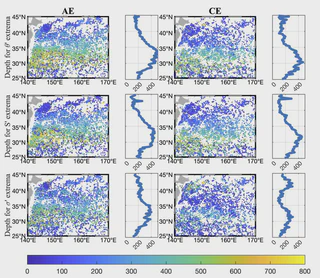 Image credit: Hengkai Yao
As a ubiquitous motion phenomenon in the ocean, mesoscale eddies play a key role in the transport and distribution of global heat, salinity, energy and marine biochemical processes. The Kuroshio-Oyashio extension region is one of the regions with most abundant eddy activities in the global ocean, and it is also a hot spot for air-sea interaction in the mid-latitudes. As the intersection of the subtropical circulation and the subpolar circulation in the North Pacific, this sea area has complex ocean fronts and large-scale circulation systems, resulting in rich and diverse mesoscale eddy phenomena. The study of mesoscale eddies in the Kuroshio-Oyashio extension region is of great significance for understanding the contribution of oceanic mesoscale phenomena in mid-latitude air-sea interactions and global multi-scale energy balance. Based on satellite observations, in situ observations of Argo profiles, and reanalysis data, this dissertation systematically studies the surface features, vertical structures and sources of the mesoscale eddies in the Kuroshio-Oyashio extension ocean.
Based on two different spatial resolutions of CMEMS satellite remote sensing data for more than 20 years and FORA-WNP30 reanalysis data for more than 30 years, the TOEddies eddy identification algorithm was used to generate tree-like eddy datasets with parent-child relationship. Comprehensive and detailed statistics of the morphological, kinematic and dynamic characteristics of mesoscale eddies in multiple sub-regions in the Kuroshio-Oyashio extension region were carried out. Statistically, it is found that the eddy characteristics under each sub-region show significant differences, which further refines the previous understanding of the eddy statistical characteristics in this region. The evolution of the eddy features in the normalized life cycle reveals significant time-reversal properties and quintile evolution.
Based on the above two sets of eddy datasets with different resolutions, the study found that the high-resolution datasets identified and tracked more eddies than the low-resolution datasets, and the eddies in the high-resolution datasets were significantly different in lifetime, amplitude, Radius, eddy kinetic energy (EKE), azimuthal velocity, propagation distance, nonlinear parameters and other characteristic quantities are smaller, while the characteristic quantities such as propagation velocity, eddy strength (EI), average vorticity and average deformation rate are bigger. It reveals the possible overestimation problem of eddy characteristic quantity which is limited by the resolution of eddy observation in the current global eddy statistics.
Based on the above two sets of vortex datasets and combined with Argo profile data, a composite eddy 3D structure was constructed in multiple sub-regions of the study area, and the spatial variation of the eddy 3D structure in the study area was further refined on the basis of previous research. Based on the mathematical similarity of the temperature-salt density profiles in the eddy, this paper uses the hierarchical clustering method to perform cluster analysis on the eddy for the first time, and obtains four typical vertical eddy structures (surface type 1, surface type 2) in this area, subsurface type and middle-layer type, compared with the traditional sub-region method, the typical eddy vertical structure obtained in this study is more representative, eliminating the vertical structure hybrid phenomenon that is difficult to remove in the traditional method.
Based on the eddy parent-child relationship and water mass analysis in the above two sets of eddy datasets, a traceability analysis of the above typical vertical vortex structures was carried out to find the source of each type of eddies. Surface type 1 eddies are generated in the Oyashio extension (OE) region north of the Subarctic Boundary (SAB), where anticyclonic eddies (AE) are mainly generated near the Subarctic Front (SAF), while Generated near the Oyashio Intrusion (OI); surface type 2 eddies are generated in the Recirculation Gyre (RG) region and the central North Pacific; subsurface eddies are generated south of the Subarctic Boundary (SAB) and the Kuroshio extension (KE) North of the Kuroshio axis; middle-layer type eddies are generated over a broad area south of KE and in the central North Pacific. The different types of vortices can be divided into different unstable structures through linear baroclinic instability analysis.
Based on the results of the above cluster analysis, this paper discusses several main factors affecting the vertical structure of the eddies in this region, including the flow system and instability mechanism in the eddy generation stage, and the vertical displacement of the water column in the eddies caused by the eddy itself, the effect of background stratification changes in the pathway region during eddy propagation, the interaction of air-sea interaction on the vertical structure of surface-type eddies, and the possibility of diapycnal mixing.
Based on the TOEddies algorithm, a dataset of eddy events (splitting and merging) was generated for this study, and the vertical structure of eddies during their life cycle was discussed for both non-eddy-event eddies and eddy-event eddies. It was found that the eddy structure in non-eddy events remained relatively stable, while in eddy events, the eddy core underwent a significant vertical displacement of over 70m before and after the event."


Professor College of Oceanic and Atmospheric Sciences Ocean University of China 238 Songling Rd, Qingdao 266100, China Tel: +86-532-66781820 Email: lanjian@ouc.edu.cn
EMPLOYMENT 07/2009-12/2013, Lecture, Ocean University of China 01/2014-present, Associate Professor, Ocean University of China
2006/12-present, Professor in College of Oceanic and Atmospheric Sciences, Ocean University of China, Qingdao, China 2008/06-2009/06, Visiting Scientist in School for Marine Science and Technology, University of Massachusetts at Dartmouth, Massachusetts, USA 2001/12-2006/12, Associate professor in College of Physical and Environmental Oceanography, Ocean University of China, Qingdao, China 2001/08-2002/08, Visiting Scholar in Department of Oceanography, Naval Postgraduate School, California, USA 1998/07-2001/12, Lecturer in College of Physical and Environmental Oceanography, Ocean University of China, Qingdao, China 1998/11-1999/12, Visiting Scholar in Department of Oceanography, Naval Postgraduate School, California, USA
REFEREED PUBLICATIONS Ma, J., and J. Lan*, 2016: Interannual variability of Indian Ocean subtropical mode water subduction rate.Clim. Dyn., doi:10.1007/s00382-016-3322-1. Zhang, N., J. Lan*, J. Ma and F. Cui, 2016: The shallow meridional overturning circulation in the South China Sea and the related internal water movement. Acta Oceanol. Sin., Vol.35(7), 1-7, doi: 10.1007/s13131-016-0900-3. Zhang, N., M. Feng*, Y. Du, J. Lan, and S. E. Wijffels (2016), Seasonal and interannual variations of mixed layer salinity in the southeast tropical Indian Ocean, J. Geophys. Res. Oceans, 121, 4716–4731, doi:10.1002/2016JC011854. Lan, J. , Y. Wang, F. Cui and N. Zhang, 2015: Seasonal Variation in the South China Sea Deep Circulation, J. Geophys.Res. Oceans, 120, 1682-1690, doi:10.1002/2014JC010413. Sun, S., J. Lan, Y. Fang, C. Tana and X. Gao, 2015: A triggering mechanism for the Indian Ocean Dipoles independent of ENSO. J. Climate, doi:10.1175/JCLI-D -14-00580.1. Song, W., J.Lan, Q. Liu, D. Sui, L. Zeng and D. Wang, 2014: Decadal variability of heat content in South China Sea inferred from observation data and an ocean data assimilation product. Ocean Sci., Vol.10, 135-139, doi:10.5194/os-10-135- 2014. Wang, Y., J.Lan*, and F. Cui, 2014: Effect of nonlinear advection on the Indian Ocean dipole asymmetry. Acta Oceanol. Sin., Vol.33(1), 77-82, doi: 10.1007/s13131-014-0420-y. Lan, J. , N. Zhang, and Y. Wang, 2013: On the dynamics of the South China Sea deep circulation, J. Geophys.Res. Oceans, 118, 1206-1210, doi:10.1002 /jgrc. 20104. Ogata, T., S-P. Xie, J.Lan, X. Zheng, 2013: Importance of Ocean Dynamics for the Skewness of the Indian Ocean Dipole Mode, J. Climate, 26, 2145-2159, doi: 10.1175/JCLI-D-11-00615.1. Lan, J.*, N. Zhang, C. Wang, 2012: The destiny of the North Pacific Intermediate Water in the South China Sea. Acta Oceanol. Sin., Vol.31(5), 41-45, doi: 10.1007/s13131-012-0234-8. Jia, F., L. Wu, J.Lan, B. Qiu, 2011: Interannual modulation of eddy kinetic energy in the southeast Indian Ocean by Southern Annular Mode, J. Geophys. Res., 116, C02029, doi:10.1029/2010JC006699. Lan, J., J.L. Hong and Y. Wang, 2009: Relationship of the interannual variability of the Indonesian Throughflow with the IOD over tropical Indian Ocean.Theor. Appl. Climatol., Vol.97, 75-79, DOI 10.1007/s00704-008-0066-9.
Courses Undergraduate: Physical Oceanography
Research Interests Abyssal circulation dynamics and numerical modeling; Ocean circulation and climate; Ocean data assimulation.


Associate Professor College of Oceanic and Atmospheric Sciences Ocean University of China 238 Songling Rd, Qingdao 266100, China Tel: +86-532-66782802 Email:machao@ouc.edu.cn
Education 09/2000-06/2003, B.S. in Marine Science, Ocean University of China 09/2003-06/2006, M.S. in Physical Oceanography, Ocean University of China 09/2006-06/2009, Ph.D. in Physical Oceanography, Ocean University of China 09/2007-09/2008, Joint Ph.D. candidate, Woods Hole Oceanographic Institution
EMPLOYMENT 07/2009-12/2013, Lecture, Ocean University of China 01/2014-present, Associate Professor, Ocean University of China
Major PROJECTS 01/2017-12/2020, NSFC project “On the multi spatial and temporal scale variations of the Kuroshio and its exchange process with the coastal sea” (41676004), 700k, PI 01/2014-12/2017, NSFC project “The Coupled Ocean-Atmosphere Processes in the Kuroshio Extension Region and Their Effects on Circulations in the East Asian Marginal Seas” (41376001), 960k, PI 01/2011-12/2013, NSFC project “The Effect of Abnormal Signals to the East of Japan on Seasonal Variations of the Tsushima Strait Warm Current and Sea Level in the Japan/East Sea” (41006003), 200k, PI 07/2012-12/2014, Promotive Research Fund for Excellent Young and Middle-aged Scientists of Shandong Province “Seasonal variability of the Tsushima Warm Current and its effect on the Yellow Sea Warm Current” (BS2012HZ019), 50k, PI 07/2010-07/2012, Fundamental Research Funds for the Central Universities “Study on the mechanism for seasonal variations of the Yellow Sea Warm Current and the sea level in Chinese coastal waters” (201013021),80k,PI 01/2015-08/2019, National Basic Research Program of China (973) project “Response of the Meridional Overturning Circulation in the Antarctic Circumpolar Current to global warming and its effect on climate change” (2015CB954300), 4.9m, Participant 01/2014-08/2018, National Basic Research Program of China (973) project “Generation and dissipation of oceanic mesoscale eddies and horizontal eddy mixing mechanisms around islands” (2014CB745001), 3.6m, Participant
REFEREED PUBLICATIONS Ma, C., D. Wu, X. Lin, J. Yang, and X. Ju, 2012: On the Mechanism of Seasonal Variation of the Tsushima Warm Current. Cont. Shelf Res., 48, 1-7, doi:10.1016/j.csr.2012.08.013 Ma, C., D. Wu, X. Lin, J. Yang, and X. Ju, 2010: An open-ocean forcing in the East China and Yellow Seas. J. Geophys. Res., 115, C12056, doi:10.1029/2010JC006179 Ma, C., J. Yang, D. Wu, and X. Lin, 2010: The Kuroshio Extension: a leading mechanism for the seasonal sea-level variability along the west coast of Japan. Ocean Dynam., 60(3), 667-672 Ma, C., D. Wu, and X. Lin, 2009: Variability of surface velocity in the Kuroshio Current and adjacent waters derived from Argos drifter buoys and satellite altimeter data, Chin. J. Oceanol. Limnol., 27(2), 208-217 Xu, L., X. Lin, and C. Ma, 2009: Mechanism of the Yellow Sea Warm Current and its seasonal variation, J. Hydrodynamics, 21(2), 159-165
Awards Wu, D., X. Lin, X. Wan, X. Chen, C. Ma, X. Bao, and J. Song, 2013: The Dynamics Framework and Variability of Ocean Environment in the East China Coastal Seas, First prize of Natural Science Award of the Ministry of Education, 2012-21 Wu, D., X. Chen, X. Bao, X. Lin, J. Song, C. Ma, X. Han, H. Yu, L. Qiao, P. Zheng, and G. Wang, 2015: Study on the key processes of ocean dynamic environment in the East China Sea and their fine numerical simulations and applications, First prize of Science and Technology Award of China Association of Oceanic Engineering, 2014-01-01
Courses Undergraduate: Ocean Circulation; FORTRAN Programming
Research Interests Numerical and theoretical studies of ocean circulation; Interactions between open ocean and marginal seas.