Introducing the New Regional Community Earth System Model, R-CESM
August 10, 2023· ,
,
 ,
, ,
, ,
, ,,,
,,,
 ,,,,,·
0 min read
,,,,,·
0 min read
Dan Fu
Justin Small
Corresponding
Jaison Kurian
Yun Liu
Brian Kauffman
Abishek Gopal
Brian Kauffman
Abishek Gopal
Sanjiv Ramachandran
Zhi Shang
Ping Chang
Gokhan Danabasoglu
Katherine Thayer-Calder
Mariana Vertenstein
Xiaohui Ma
Hengkai YAO
Mingkui Li
Zhao Xu
Xiaopei Lin
Shaoqing Zhang
Lixin Wu
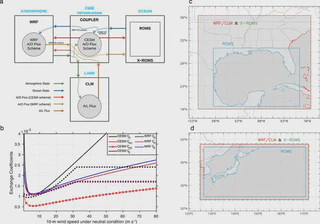 Image credit: Dan Fu
Abstract
The development of high-resolution, fully coupled, regional Earth system model systems is important for improving our understanding of climate variability, future projections, and extreme events at regional scales. Here we introduce and present an overview of the newly developed Regional Community Earth System Model (R-CESM). Different from other existing regional climate models, R-CESM is based on the Community Earth System Model version 2 (CESM2) framework. We have incorporated the Weather Research and Forecasting (WRF) Model and Regional Ocean Modeling System (ROMS) into CESM2 as additional components. As such, R-CESM can be conveniently used as a regional dynamical downscaling tool for the global CESM solutions or/and as a standalone high-resolution regional coupled model. The user interface of R-CESM follows that of CESM, making it readily accessible to the broader community. Among countless potential applications of R-CESM, we showcase here a few preliminary studies that illustrate its novel aspects and value. These include 1) assessing the skill of R-CESM in a multiyear, high-resolution, regional coupled simulation of the Gulf of Mexico; 2) examining the impact of WRF and CESM ocean–atmosphere coupling physics on tropical cyclone simulations; and 3) a convection-permitting simulation of submesoscale ocean–atmosphere interactions. We also discuss capabilities under development such as (i) regional refinement using a high-resolution ROMS nested within global CESM and (ii) “online” coupled data assimilation. Our open-source framework (publicly available at https://github.com/ihesp/rcesm1) can be easily adapted to a broad range of applications that are of interest to the users of CESM, WRF, and ROMS.
Type
Publication
Bulletin of the American Meteorological Society

Authors


Authors

Authors

Authors

Authors
Professor of Oceanography
Dr. Chang’s expertise is on climate dynamics and climate prediction, as well as global and regional climate modeling. He leads a research group in global and regional climate modeling studies at TAMU and has developed research collaborations with many institutions in the US, Asia and Europe. Dr. Chang’s research involves the understanding of climate variability and predictability, including El Niño-Southern Oscillation (ENSO), Tropical Atlantic variability (TAV) and Atlantic Multidecadal Variability (AMV). He has published over 164 refereed journal articles (http://scholar.google.com/citations?User=ciw1niuaaaaj&hl=en), with some of his research being used to guide the design of major international research programs, such as the Climate and Ocean-Variability, Predictability and Change (CLIVAR) Research Program (http://www.clivar.org). He co-chaired the International CLIVAR Atlantic Research Panel (http://www.clivar.org/clivar-panels/atlantic) and was a contributing author to three chapters in the Fifth Assessment Report (AR5) of the Inter-governmental Panel on Climate Change (IPCC). He is currently the Director of the International Laboratory for High-Resolution Earth System Prediction (iHESP) at Texas A&M University where he and his collaborators have made ground breaking work on climate modeling and prediction.
Authors
Authors
Authors


Authors
Hengkai YAO
(he/him)
Ocean Scientist
Dr. Hengkai Yao (姚恒恺) is a lecturer of School of Mathmetica and Physics at the Qingdao University of Science and Technology. He got Ph.D of Physical Oceanograpy from Ocean University of China. His research interests include mesoscale eddies, ocean modeling and AI oceanography. He is member of the Shandong Engineering Research Center for Marine Scenarized Application of Artificial Interlligence Rechnology, which develops big data in ocean, ocean simulation, and ocean prediction. He is also a chief scientist in Qingdao Oakfull Water Technology Co., Ltd.
Authors
Authors
Authors
Authors
Authors