Ping Chang

Ping Chang

Professor of Oceanography
Dr. Chang’s expertise is on climate dynamics and climate prediction, as well as global and regional climate modeling. He leads a research group in global and regional climate modeling studies at TAMU and has developed research collaborations with many institutions in the US, Asia and Europe. Dr. Chang’s research involves the understanding of climate variability and predictability, including El Niño-Southern Oscillation (ENSO), Tropical Atlantic variability (TAV) and Atlantic Multidecadal Variability (AMV). He has published over 164 refereed journal articles (http://scholar.google.com/citations?User=ciw1niuaaaaj&hl=en), with some of his research being used to guide the design of major international research programs, such as the Climate and Ocean-Variability, Predictability and Change (CLIVAR) Research Program (http://www.clivar.org). He co-chaired the International CLIVAR Atlantic Research Panel (http://www.clivar.org/clivar-panels/atlantic) and was a contributing author to three chapters in the Fifth Assessment Report (AR5) of the Inter-governmental Panel on Climate Change (IPCC). He is currently the Director of the International Laboratory for High-Resolution Earth System Prediction (iHESP) at Texas A&M University where he and his collaborators have made ground breaking work on climate modeling and prediction.
Research on vertical structure and origin of eddies in Kuroshio-Oyashio Extension region featured image

Research on vertical structure and origin of eddies in Kuroshio-Oyashio Extension region

As a ubiquitous motion phenomenon in the ocean, mesoscale eddies play a key role in the transport and distribution of global heat, salinity, energy and marine biochemical …

avatar
Hengkai YAO
Introducing the New Regional Community Earth System Model, R-CESM featured image

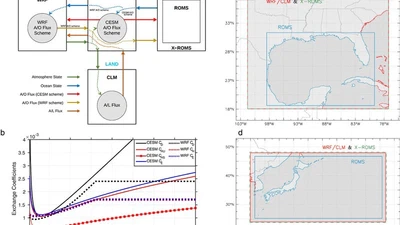
Introducing the New Regional Community Earth System Model, R-CESM

The development of high-resolution, fully coupled, regional Earth system model systems is important for improving our understanding of climate variability, future projections, and …

avatar
Dan Fu
Asymmetric vertical structure of mesoscale eddies in the Kuroshio Extension region featured image

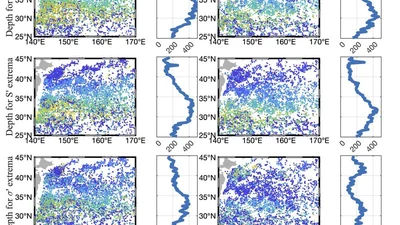
Asymmetric vertical structure of mesoscale eddies in the Kuroshio Extension region

The Kuroshio Extension (KE) region in the Northwestern Pacific Ocean is one of the most eddy-energetic regions of the global ocean. In the past decades, much has been investigated …

avatar
Hengkai YAO
 |   |